Better together: JITM and Mistral's Timestral
Pairing Mistral's new Timestral model with a JITM correction model cut forecasting error by 7–23% against our previous Morrowatt models in a 45-day historical test. It also edged ahead of Timestral alone in all four comparisons, with the clearest gain in Spain three days ahead. Live evaluation is now underway.
Morrowatt in one minute
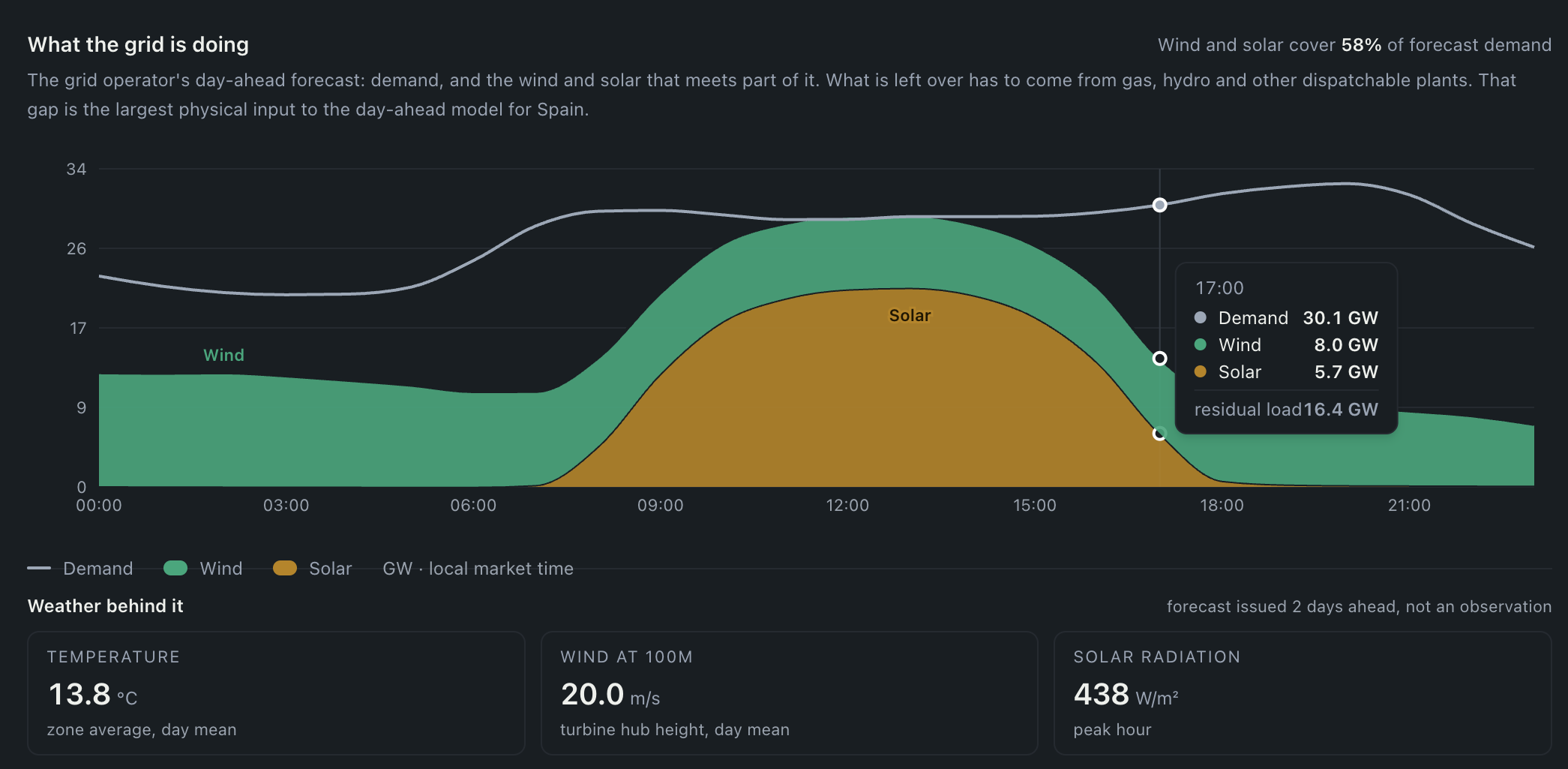
The price of electricity changes every hour. In Europe, tomorrow's hourly prices are set in a daily auction, and they swing a lot: cheap when the wind is blowing or the sun is high, expensive on a still winter evening when gas plants have to fill the gap. Morrowatt, built and run on JITM, forecasts those prices for Germany and Spain up to three days ahead, so households and businesses can move flexible use, like charging a car, heating water or running a heavy machine, into the cheapest hours. To do that it looks at what drives the price: how much power people will need, how much wind and solar is coming, the weather, and the price of gas.
Meet Timestral
On 15 October, Mistral AI released Timestral, its first family of foundation models for time series: models trained on a huge variety of data so they can forecast almost anything that changes over time, straight out of the box. Mistral reports that its largest version, which we used, ranks first on the field's main public benchmarks. On power prices it is very good at reading rhythm: the daily double peak, quiet weekends, and how today's level carries into tomorrow. What a general-purpose model does not have is local knowledge: years of experience of how this particular market reacts when the wind drops or gas jumps.
Two kinds of intelligence
So we let each do what it is best at. Timestral makes the first forecast. JITM then acts as a specialist editor. Timestral was only released in October, so to train the editor we went back and recreated the forecast Timestral would have made for every day since January 2024, each one using only the information available at the time. JITM studied those forecasts side by side with what prices actually did, together with everything Morrowatt knows about each hour. It learned when Timestral tends to miss, in which direction and by how much, and applies that correction to every new forecast. Neither model has to be good at everything. The combination only needs each to be good at its part.
The results
We tested on 7 September to 21 October 2026: 45 days held out from JITM's training, scored hour by hour against the real auction prices. Three approaches went head to head: JITM on its own (our previous Morrowatt models), Timestral on its own, and the two combined. We scored forecasts made two and three days ahead, the hardest part of Morrowatt's job.
| Average miss, €/MWh | JITM alone | Timestral alone | JITM + Timestral |
|---|---|---|---|
| Germany, 2 days ahead | 25.8 | 21.9 | 21.8 |
| Spain, 2 days ahead | 24.7 | 19.4 | 19.0 |
| Germany, 3 days ahead | 32.9 | 28.3 | 28.2 |
| Spain, 3 days ahead | 26.9 | 26.6 | 25.0 |
These are two different findings. Against our previous models, the combination cut error by 7 to 23% and was better on 118 of 180 forecast days: a clear step up. Against Timestral on its own, which is already excellent, the gap is smaller but goes the same way in all four comparisons, with the biggest gain in Spain three days ahead (6% less error). The chart below shows every week of the test, hour by hour: switch market, switch how far ahead, and page through the weeks. Nothing is hand-picked, and you will find weeks where Timestral or JITM alone came out on top. Over the whole test, though, the combination was the closest of the three more often than either.
Out of 180 forecast days: Germany and Spain, 2 and 3 days ahead, 7 Sep – 21 Oct 2026. A forecast “wins” a day when its average miss across the 24 hours is the smallest of the three.
What this means for our clients
Foundation models like Timestral are a real step forward, and they will keep getting better. But a general model is a starting point, not a finished product. The accuracy that matters for a decision comes from fitting it to your own market, your own data and your own question, and from checking it every day against what really happened. That is what JITM does. In our bespoke prediction work, Timestral is now part of the toolkit, alongside JITM's own model families, used wherever it makes the result more accurate. As new frontier models arrive, we will test them the same way and put the best of them to work. Our job is not to defend one model. It is to give our clients the most accurate forecast available, and to prove it.
Cheapest four hours, straight to your calendar
First, where things stand: Morrowatt's site and calendars still run on our previous JITM models today. The combination runs alongside them, and takes over once it has proven itself live. A forecast is only useful if it changes what you do. Morrowatt turns its forecasts into one simple answer for each day: the cheapest four-hour block to use power, up to three days ahead, with the star marking the cheapest of the three days.
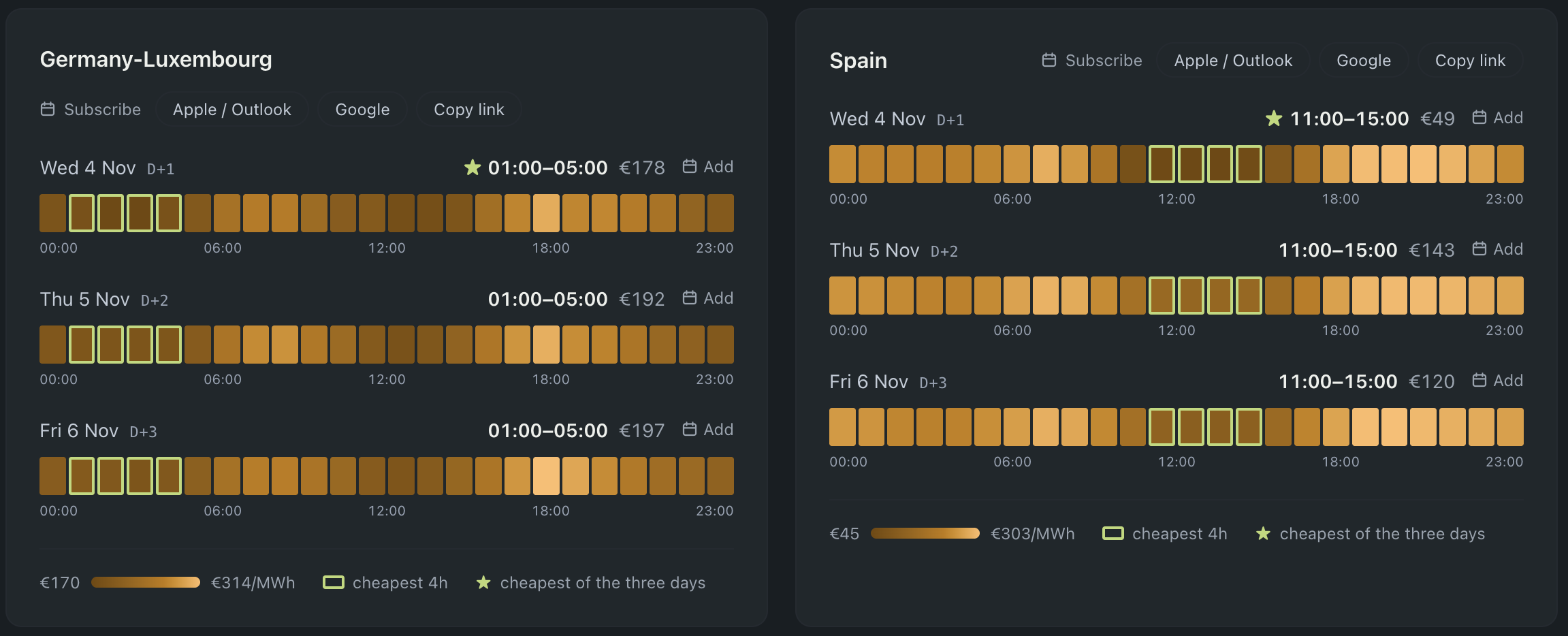
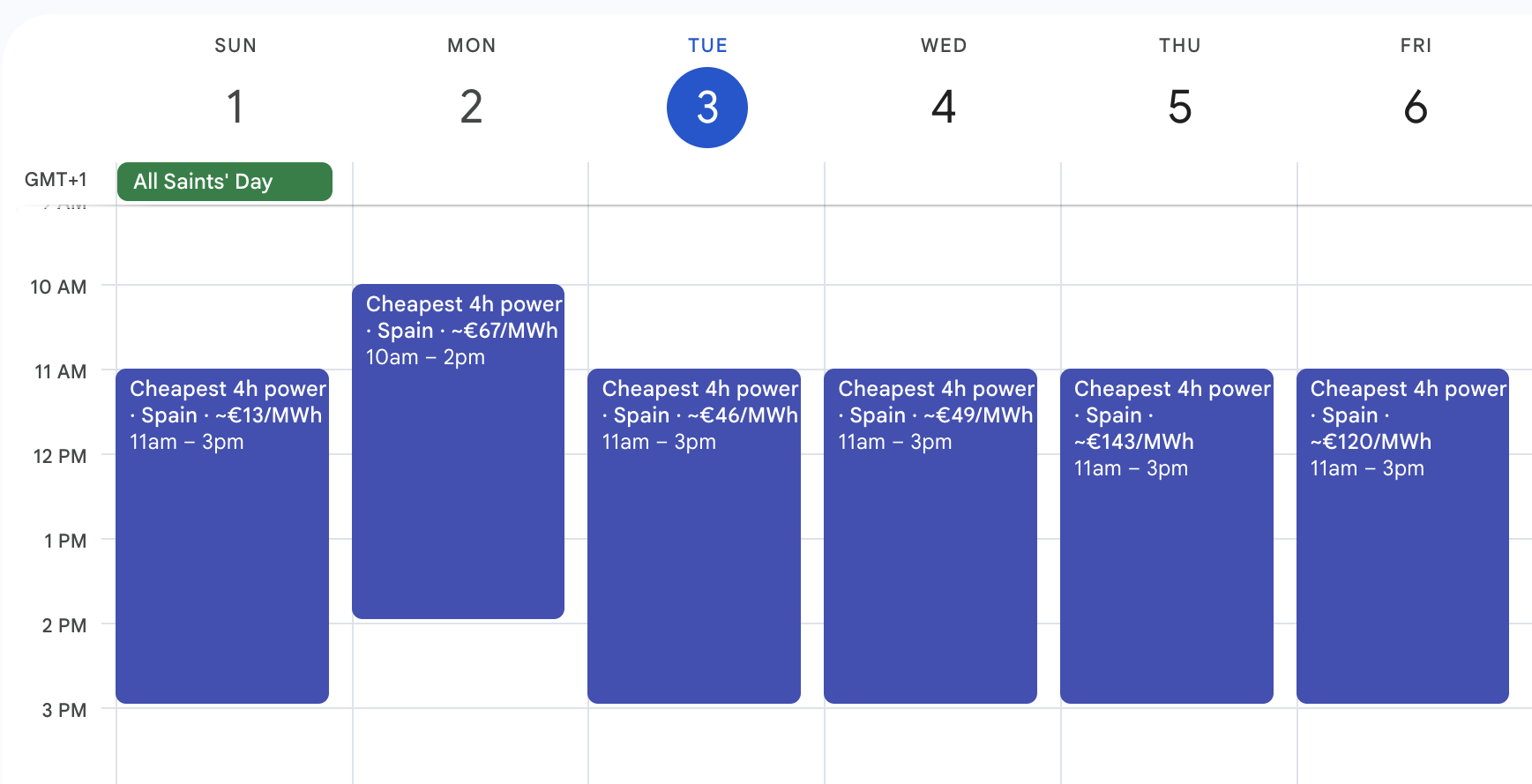
Subscribe once, from Apple Calendar, Outlook or Google Calendar, and the cheapest window appears in your calendar every day, with its expected price. It also keeps itself up to date: as the day gets closer and the forecast firms up from three days out to two, and then to one, the event moves on its own. There is nothing to refresh and nothing to re-import.
Does a more accurate forecast pick a cheaper window? We checked. In the same 45-day test, all three approaches found the exact cheapest four hours on about six days in ten (108 to 111 of 180), and on the days they missed, the window they chose cost on average only €1.30 to €1.60 per MWh more than the best one. For choosing the window, the combination is as good as our current models, not yet measurably better. That is the number we most want to move, and the one we will report from live use.
For the geeks
Timestral-209M, used as released (zero-shot): 4,096 hours of price history ending at the last published auction, plus weather forecasts, TTF gas, holidays, weekends and lagged residual load, giving five quantiles per hour. Its forecasts for January 2024 to October 2026 were recreated one delivery day at a time, with the same inputs and cut-offs as live. The JITM model learns the gap between price and Timestral's median, both divided by the gas price, from Morrowatt's features plus Timestral's quantiles; it was trained on January 2024 to 6 September 2026, grouped by delivery day. "JITM alone" is our previous gas-normalised model with the same cut-off. Average daily error, combined minus Timestral: −0.1, −0.4, −0.1 and −1.6 €/MWh for the four rows above. Cheapest-window choice, average €/MWh above the true cheapest 4-hour block over 180 forecast days: JITM alone 1.32, Timestral 1.62, combined 1.39. Day-ahead (1 day) results are not included here.